
Fashion PLM Software in 2026: Enterprise Power, Less Friction
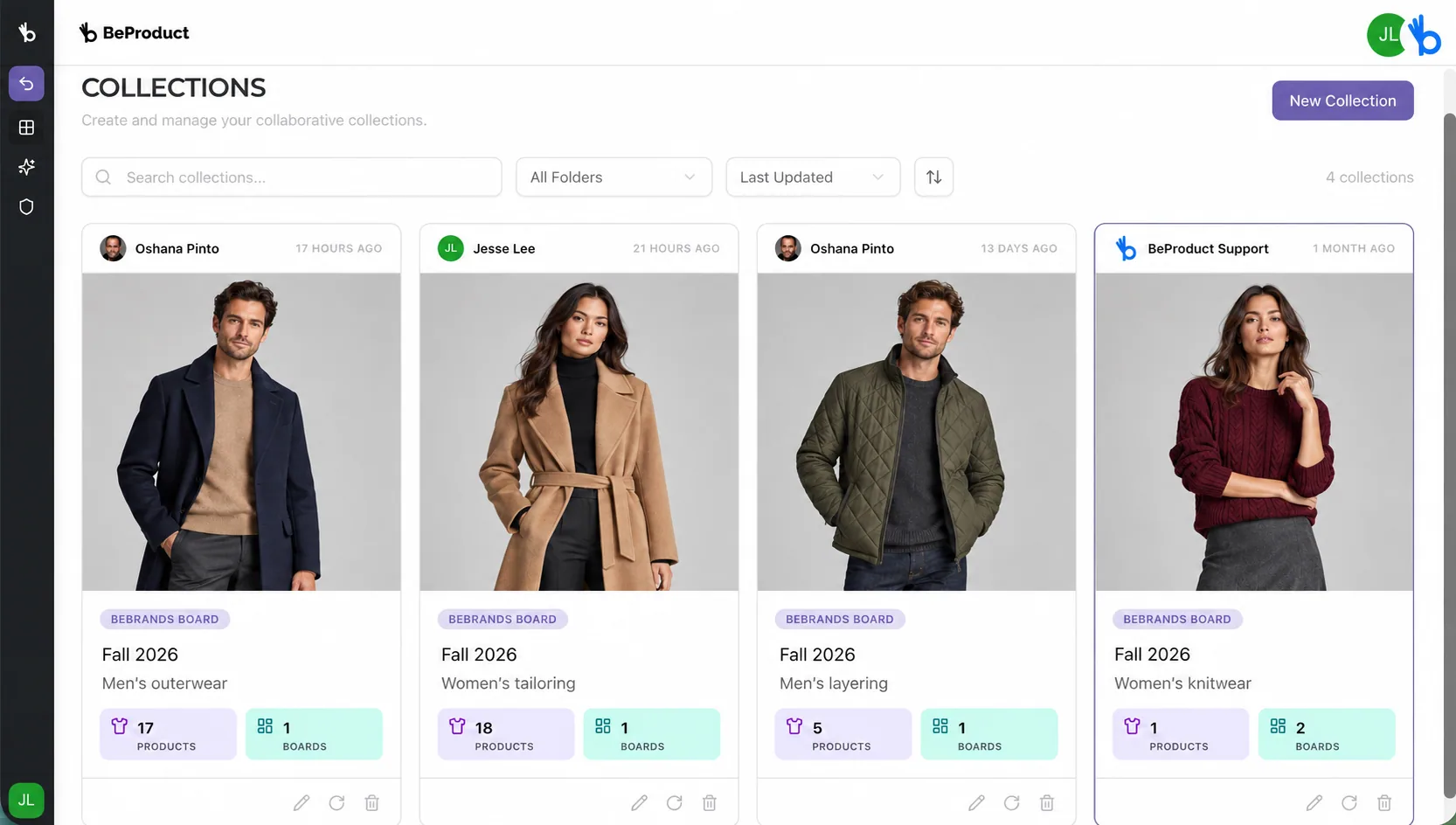
A buyer asks for an exclusive colorway. A designer updates the fabric. Development changes a specification. Tomorrow’s presentation still contains yesterday’s product.
That is the kind of problem a fashion PLM should solve. The product record, the people making decisions and the tools doing the work need to stay connected, even when the collection changes.
Searching for the best fashion PLM software in 2026 brings up plenty of confident claims. A more useful starting point is what happens after selection: how soon your team can do meaningful work, how easily the platform adapts and what it takes to keep improving it.
BeProduct brings product lifecycle management, digital product creation, configurable workflows and connected visual tools into that conversation. Its case goes beyond subscription cost. It is about giving emerging brands, wholesale businesses and enterprise teams the capability to grow without making everyday product development unnecessarily difficult.
What is the best fashion PLM for your business?
The best fashion PLM is the one that handles your product complexity, earns adoption across your team and remains practical to change. Evaluate the combination: fashion-specific functionality, time to value, customization, integration, service and the cost of running the system over time.
For teams prioritizing flexible product development alongside connected 3D and AI workflows, BeProduct offers a compelling combination. The right way to assess it is with your own styles, materials, approval steps and systems in a working demonstration.
What does fashion PLM actually manage?
Product lifecycle management organizes the information and collaboration needed to develop a product. In apparel, that can include sketches, fabrics, trims, colors, specifications, bills of materials, samples, development milestones and technical handoffs.
Imagine a jacket developed in several sizes and colorways for two retail accounts. A material substitution can affect more than a single field: designers need to review the appearance, developers need current specifications and the supplier needs the correct instructions. A useful PLM makes those relationships easier to manage.
BeProduct’s fashion PLM includes shared color, material and digital asset libraries, product specifications, tech packs, tracking and collaboration. Those capabilities give teams a common place to work through changes instead of reconstructing decisions from separate files.
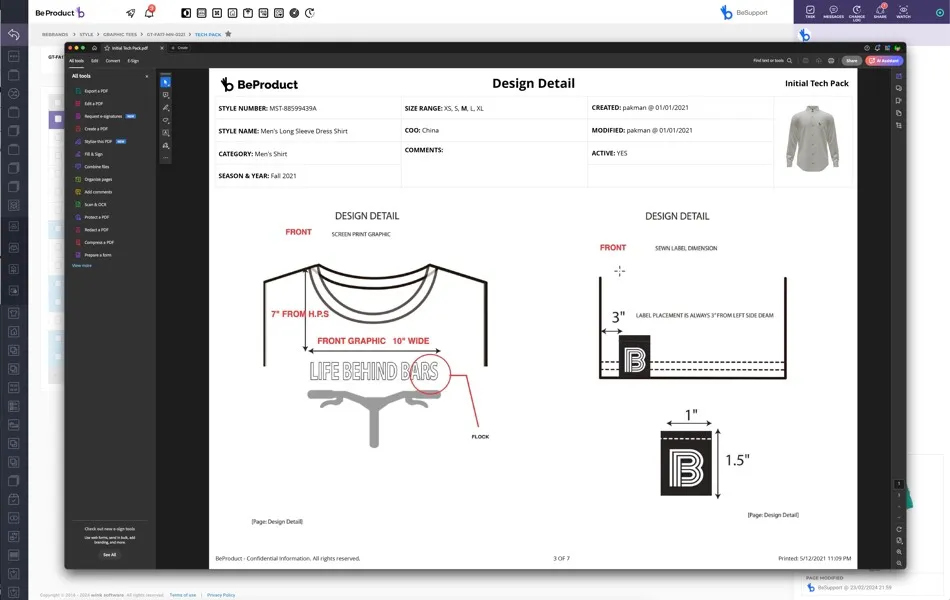
From design to technical handoff: a BeProduct tech pack brings garment details and placement instructions into one document.
PLM and ERP solve different parts of the business
PLM focuses on defining and developing the product. ERP typically manages operational transactions such as purchasing, inventory, orders and finance, depending on the system and modules. Many fashion companies need both.
If your problem is incomplete specifications, disconnected samples or repeated product updates, start by assessing the development workflow. If it is warehouse stock or financial consolidation, assess the operational system. When both are involved, agree which system owns each record and how approved information passes between them.
Evaluate BeProduct as the product development layer in your wider software environment, with clear handoffs to the systems that manage operational transactions.
Enterprise power should make work easier
Enterprise capability has to show up in real work: coordinating more products, supporting more contributors and handling more demanding processes. A long feature list cannot tell you how much effort that work will require.
Usability expert Jakob Nielsen makes a useful distinction in Enterprise Usability: software must work for individuals, groups and the organization over time. For PLM buyers, that means evaluating the designer’s daily tasks, the team’s handoffs and the administration needed to keep everything running.
Test all three. Ask a designer to find and revise a style. Have development and sourcing review the change. Then ask an administrator to update a field or workflow. You will learn more than you would from a polished tour of unrelated features.
Six things that separate a useful PLM from a difficult software project
1. A clear path to the first live workflow
Implementation speed matters because your product calendar keeps moving while the software is being configured. The practical question is how quickly a defined group can complete an agreed workflow with usable data.
BeProduct’s configurable apps and existing product development tools support an approach that starts with a focused business need. A first phase might connect one category’s materials, specifications and tech packs before extending into additional teams and systems.
That creates an opportunity to demonstrate value earlier. It does not mean migration, training or complex integrations disappear. Agree the initial scope, dependencies, ownership and acceptance criteria before setting the rollout date. Ask for a plan built around your business rather than a universal implementation promise.
2. Customization that stays practical as you grow
A wholesale business may need account-specific fields. An emerging brand may need a simple sample approval process. An established group may need different views and workflows across categories. Good customization accommodates those differences while keeping shared information consistent.
BeProduct’s no-code App Builder supports drag-and-drop app creation, configurable field types, validations, calculations and custom actions. Automation can connect steps across BeProduct apps. For deeper requirements, the platform provides APIs, SDKs, webhooks and serverless functions.
The advantage is having several ways to solve a requirement. Buyers should ask which changes their trained administrators can make, which need technical expertise and who maintains the result. The result is a way to adapt the platform around the work, with a clear understanding of what your team can manage itself.
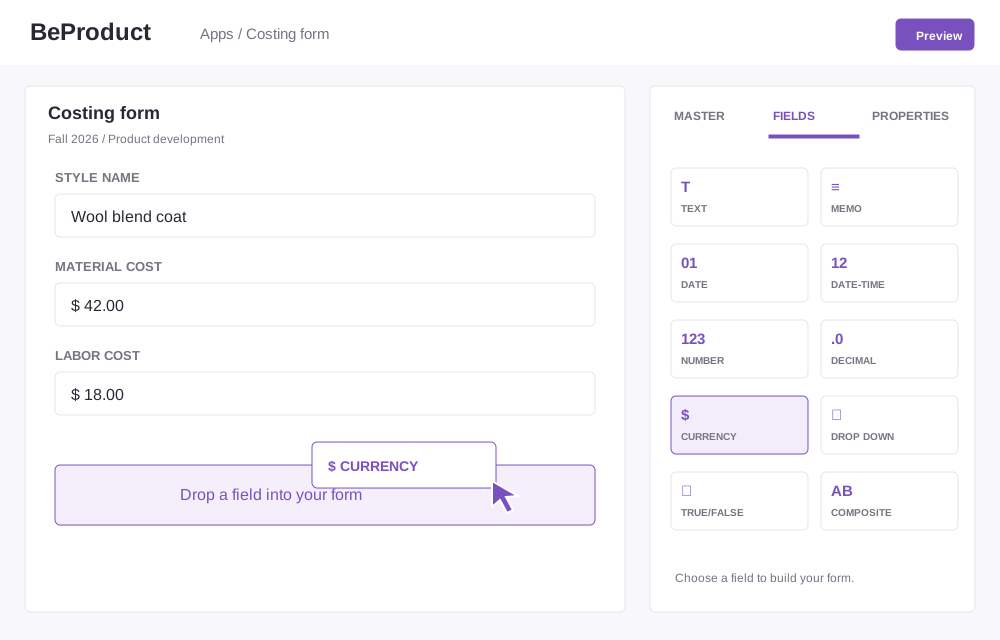
Customization made visible: this illustrative App Builder view shows fields being added to a product costing form.
3. Connections to the tools your team already uses
Product teams should be able to keep useful creative tools while improving how information moves between them. BeProduct documents connections with tools including Adobe Illustrator, Browzwear and CLO, alongside its extensibility options.
Browzwear’s own partner page describes its BeProduct integration, including synchronization of material libraries, seam libraries and seasonal color palettes, with support for the U3M open standard. That is a concrete example of connecting specialist design work with product information.
No-code tools can simplify configuration and automation; an ERP connection still needs an agreed data flow, testing and a maintenance owner. Ask the vendor to demonstrate the exact connection you require, including what happens when information is incomplete or a transfer fails.
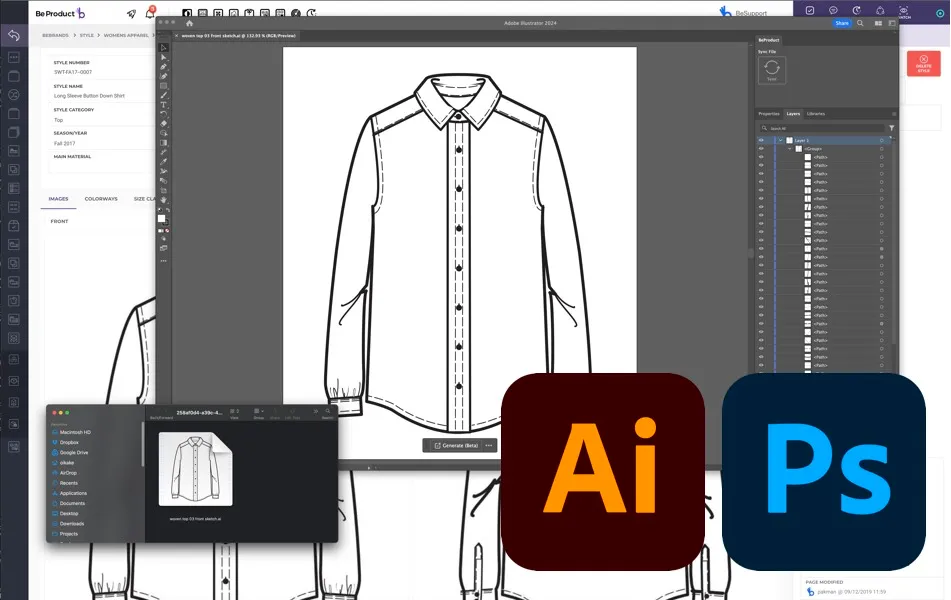
Creative tools in context: BeProduct’s Adobe integration connects garment artwork with the product development workspace.
4. AI that contributes to an actual product workflow
AI becomes more useful when the output can be reviewed in the context of the collection and the product it represents. Otherwise, teams can end up with another folder of disconnected images.
BeProduct Collections brings live product cards, collaborative visual planning and AI Studio into a shared workspace. AI Studio includes model references, pose libraries, presets, outfits and backgrounds for on-model imagery. The Collections experience also includes Try On tools.
For a merchandising team, that creates a practical opportunity: explore how real styles can be presented on consistent virtual models while colleagues review the collection together. The value lies in connecting creation, review and presentation.
Keep the purpose clear. AI-generated visualization can help teams explore and communicate a product; it does not establish physical fit, fabric performance or production readiness. Those decisions still need the appropriate technical validation.
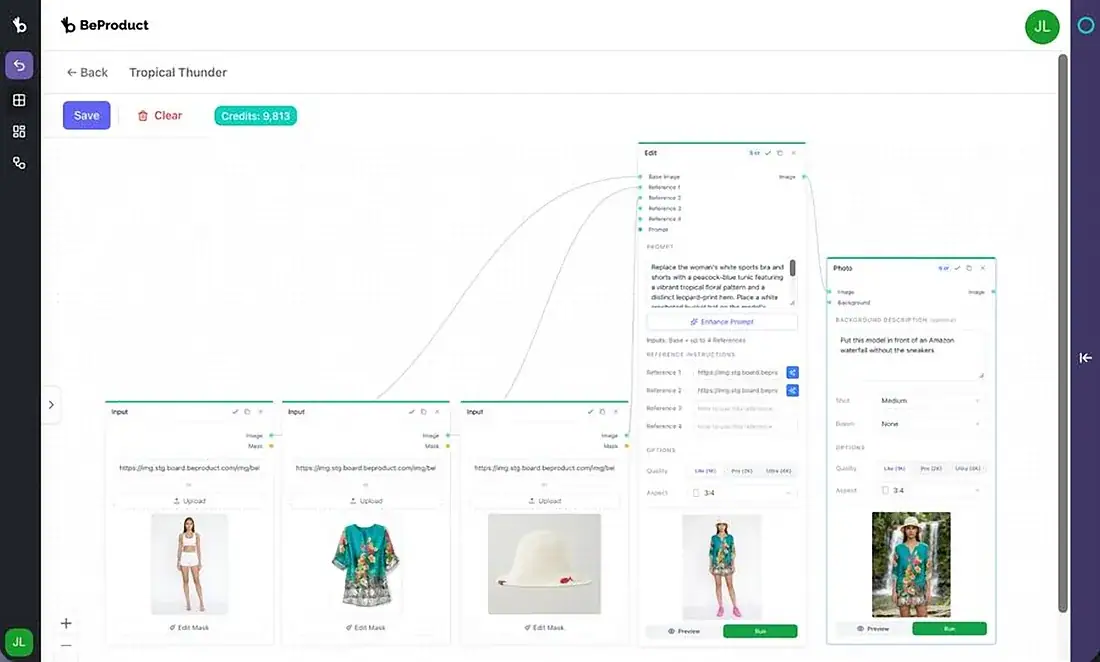
Inside AI Studio: model, garment and accessory references connect to editing and presentation steps in a visual workflow.
5. A platform with room to evolve
A PLM decision should account for what your team will need after the first season. New creative tools, changing partner systems and additional business models can all introduce requirements.
BeProduct’s combination of configurable apps, extension tools and connected digital creation gives customers options for adapting their environment. Its Collections experience shows how visual planning and AI capabilities can sit alongside product development.
The buying question is specific: when a new requirement arrives, can you configure it, connect a specialist tool or extend the platform? Ask how changes are tested and supported, and confirm feature availability in your proposed plan. An evolving platform is valuable when new capability becomes usable work.
6. Service that helps the team keep moving
Support belongs in the selection process because a blocked user or unresolved configuration question can hold up work. Ask who helps during onboarding, who owns technical issues and how the relationship continues after launch.
BeProduct’s service approach centers on working with customers as their needs develop, with contact and support routes for technical questions, customization and plan changes. Bring your actual workflow questions into those conversations.
Before purchase, establish support coverage, escalation routes, training responsibilities and any agreed response commitments. That gives “responsive service” a practical meaning for your team, rather than leaving it as a sales phrase.
How the right PLM supports different business models
Emerging brands: build structure without overwhelming the team
A small team needs shared information it can maintain while developing the next collection. Start with the work creating the most repetition: materials, specifications, sample status or tech packs. Evaluate whether BeProduct can establish that foundation within a scope your people can manage, then expand as requirements become clearer.
Wholesale companies: keep the product and the customer presentation aligned
Wholesalers often need to adapt a range for different accounts. BeProduct Collections supports client-specific colorway selection and product cards linked to the underlying records. That makes it relevant to teams preparing buyer presentations while the assortment continues to change. Demonstrate your account variations and review process during evaluation.
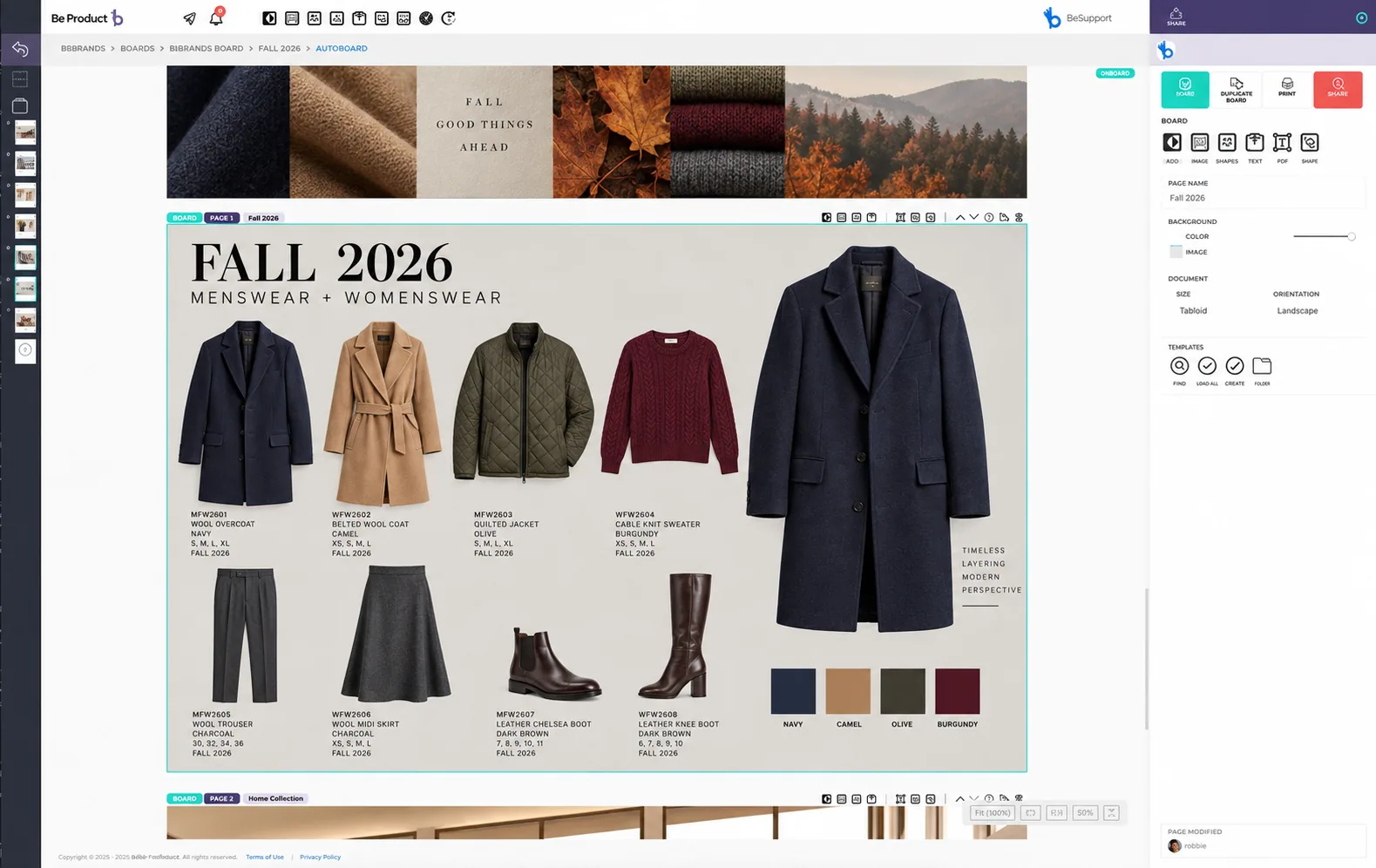
The collection as a working visual: garments, accessories, colors and product information come together for assortment review and buyer presentations.
Large corporations: combine flexibility with clear controls
Enterprise buyers should test the demanding cases: multiple teams, category differences, supplier participation, data ownership and connections to existing systems. BeProduct brings development tools and extensibility to that assessment. Validate your requirements for permissions, security, reporting, scale and governance against the proposed configuration.
What should fashion PLM really cost?
The subscription is one part of the decision. Compare implementation, migration, training, integrations, internal administration and ongoing change. Then consider the time your team currently spends reconciling files and repeating updates.
BeProduct provides tailored pricing for different business needs. Request a proposal that specifies users, capabilities, services and any additional charges. Evaluate that scope against the workflows you want to improve.
A lower license fee has limited value if the team cannot use the system effectively. Equally, a larger software investment needs to earn its place through useful capability and measurable improvements. Track outcomes such as time to issue an approved tech pack, duplicate entry and the effort required to prepare a collection review.
Bring these eight questions to your next PLM demo
Can we follow one of our own styles from initial record to approved technical handoff?
What will be usable in the first phase, and what must happen before it goes live?
Can our administrator change a field, view or approval step during the demonstration?
Which connections are already supported, and which require integration work?
Can designers, developers and merchandisers work through the same change together?
How do AI and Try On outputs relate to the product and collection being reviewed?
Who owns onboarding, support, integration maintenance and future changes?
What is included in the complete proposal, and how will we measure success?
Ask to speak with customers whose teams and workflows resemble yours. Read BeProduct customer testimonials as a starting point, then explore the implementation and everyday experience behind the comments.
Frequently asked questions
Is BeProduct suitable for both emerging brands and enterprises?
BeProduct offers tailored solutions for small teams and established enterprises. The appropriate scope depends on your product complexity, users and workflows. Start with the business requirements and build the proposal around them.
Does no-code mean every integration needs no development?
No. No-code app configuration and low-code automation can reduce development work for appropriate tasks. Connections to external systems may still require technical design, mapping, testing and maintenance.
Can AI Try On replace fit approval?
AI visualization serves a different purpose from technical fit validation. Use it to explore and present styles, while retaining the sampling and technical checks required for the product.
How quickly can a team implement BeProduct?
The timeline depends on scope, data readiness, integrations and training. Ask BeProduct to define a focused first phase and document the dependencies. A meaningful plan shows when your team can complete real work.
Why BeProduct deserves your next demo
Fashion businesses need reliable product development today and room to change tomorrow. BeProduct brings together the capabilities that make that combination credible: a fashion PLM foundation, practical customization, connected creative tools and a growing visual workspace with AI.
For an emerging brand, the opportunity is a stronger foundation for growth. For a wholesaler, it is closer alignment between the product and the buyer presentation. For an enterprise, it is the ability to assess serious development requirements alongside flexibility and everyday usability.
That is the case for BeProduct: enterprise power, a practical path to adoption and tools that can develop with the way your business works. The next step is to see those capabilities handle your collection.
Book a BeProduct demo and bring a real style, a workflow you want to improve and the systems you need to connect. Let the demonstration show what a more adaptable product development platform could mean for your team.